
F1B Goldendoodle: Coat, Shedding and Who It Suits
The F1B is the Goldendoodle generation allergy-conscious families ask about most. Here is what the backcross to a Poodle really changes, what it does not, and the coat care that comes with it.
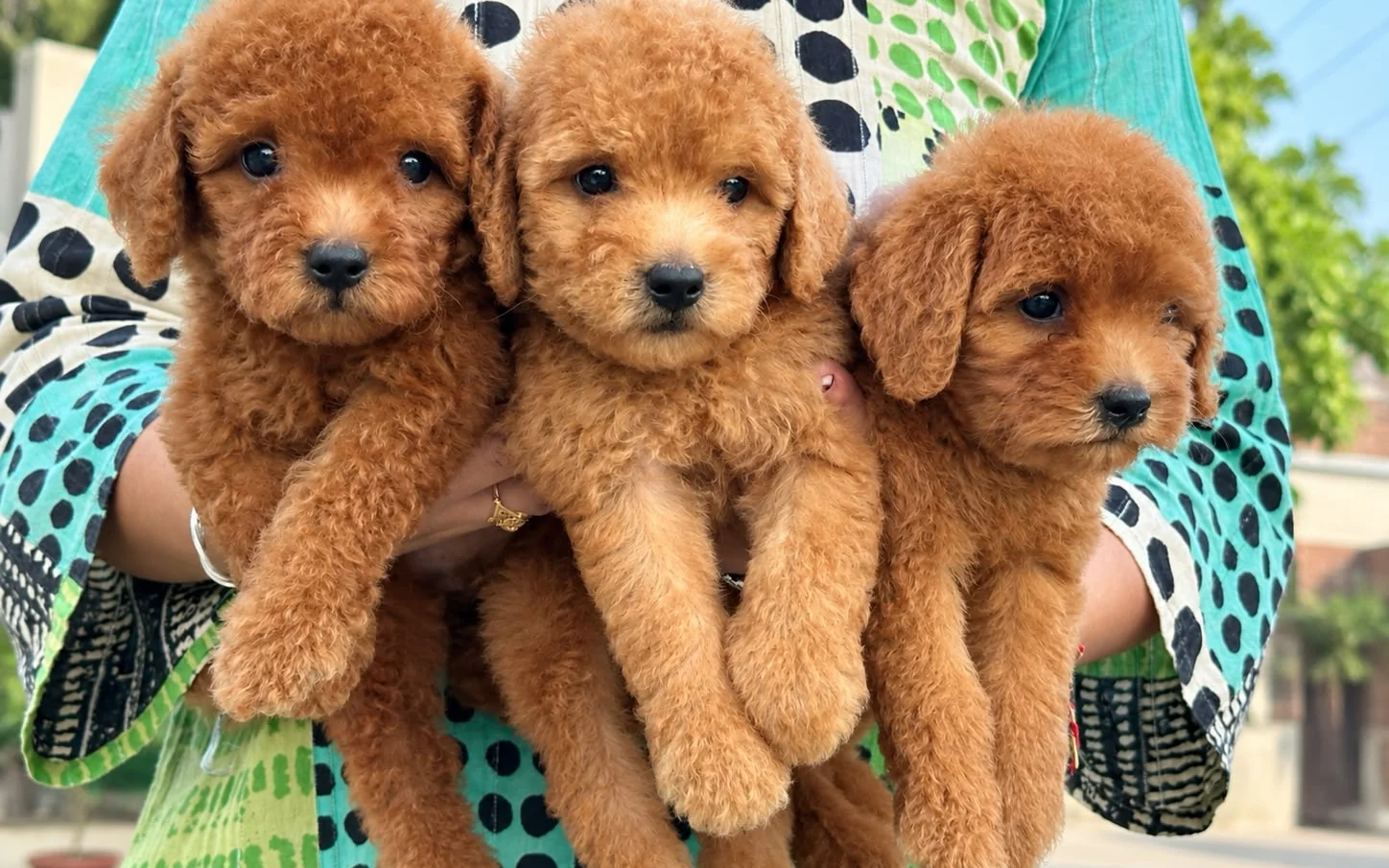
A Goldendoodle puppy, front and side
A short look at a Goldendoodle puppy from the front and the side, showing its soft, fluffy puppy coat. The video starts only when you press play.
- Parents
- F1 Goldendoodle × Poodle
- Parentage
- About 75% Poodle
- Coat
- Usually curly
- Shedding
- Usually lowest
- Grooming
- High
An F1B Goldendoodle is an F1 Goldendoodle bred back to a Poodle, about three-quarters Poodle by parentage. It usually has the curliest, lowest-shedding coat of the common Goldendoodle generations, but it is not hypoallergenic and individual puppies vary. It also needs the most coat care. For the breed as a whole, see our Goldendoodle guide, or call 7791901085 to ask which generation our current litter is.
What F1B actually means
The name is built in two steps:
- F1 is the first cross: a purebred Golden Retriever bred to a purebred Poodle. The puppies are, on average, half of each breed.
- B stands for backcross. An F1 Goldendoodle is bred back to one of the original breeds, and for a Goldendoodle that is the Poodle. Those puppies are F1B.
Averaged out, an F1B is about 75% Poodle and 25% Golden Retriever by parentage. That extra Poodle is why F1Bs are more likely to have a curly, low-shedding coat and often a quicker, more Poodle-like way of thinking.
Why “75% Poodle” is not a promise
The percentage is an average across the whole litter. It does not decide how each puppy turns out. A Goldendoodle's coat is shaped mainly by a small number of genes, including one for curl, one for the “furnishings” that give doodles their beard and eyebrows, and one associated with how much a coat sheds.
Poodles usually carry two Poodle-type copies of these genes; Golden Retrievers usually carry none. An F1 puppy gets one copy from each parent, which is why F1 coats are usually wavy and fairly similar across a litter. An F1B puppy always gets one copy from its Poodle parent, but from its F1 parent it may inherit either type. So in a typical F1B litter, some puppies inherit two curl copies and grow a tighter, curlier coat, while their littermates are wavier.
In practice, that means two F1B puppies from the same litter can look and shed differently. Coat DNA tests on the parents can show which versions of these genes they carry, and give a better guide to a litter than the generation label alone. Ask any breeder whether the parents have been coat tested.
For how the F1B compares with the F2, F1BB and multigen labels, see our Goldendoodle generations explained.
F1 or F1B: a quick comparison
| F1 Goldendoodle | F1B Goldendoodle | |
|---|---|---|
| Parents | Golden Retriever × Poodle | F1 Goldendoodle × Poodle |
| Parentage | About 50% Poodle | About 75% Poodle |
| Typical coat | Usually wavy; can be straighter | Usually curlier and tighter |
| Shedding | Low to moderate; varies from puppy to puppy | Usually the lowest, though not guaranteed |
| Grooming | Brush 2–3 times a week; a wavy coat is a little more forgiving | Brush 2–3 times a week to the skin; mats fastest |
| Predictability | Fairly consistent within a litter, but coats vary | More consistent curl, though individual puppies still vary |
| Often suits | Families who want a lower-shedding dog with slightly easier coat care | Households where shedding or mild allergies are the main concern |
Neither generation is better for every home. An F1B trades a little more grooming for a little less hair; an F1 does the opposite.
F1B Goldendoodles and allergies
Most families who ask about an F1B do so because someone at home reacts to dogs, or because nobody wants hair on the furniture. Here is the honest picture.
Most dog allergies are a reaction to proteins in dander and saliva, not to hair itself. Those proteins travel around a home on shed hair. A tight, curly coat holds shed hair inside the coat rather than dropping it, so less of it reaches the floor, the sofa and the air. For many people with mild allergies, that makes a noticeable difference.
But no dog is hypoallergenic, and an F1B still produces dander and saliva. People react differently, and so do individual dogs. If allergies are the deciding factor:
- Spend time with adult F1B Goldendoodles, indoors, before you commit.
- Talk to your doctor if the allergy is more than mild.
- Plan for regular grooming and cleaning; a well-kept coat and home help too.
The F1B coat is work
Curl and matting are two sides of the same coat. The tighter the curl, the faster loose hair tangles into mats, usually close to the skin where you cannot see them.
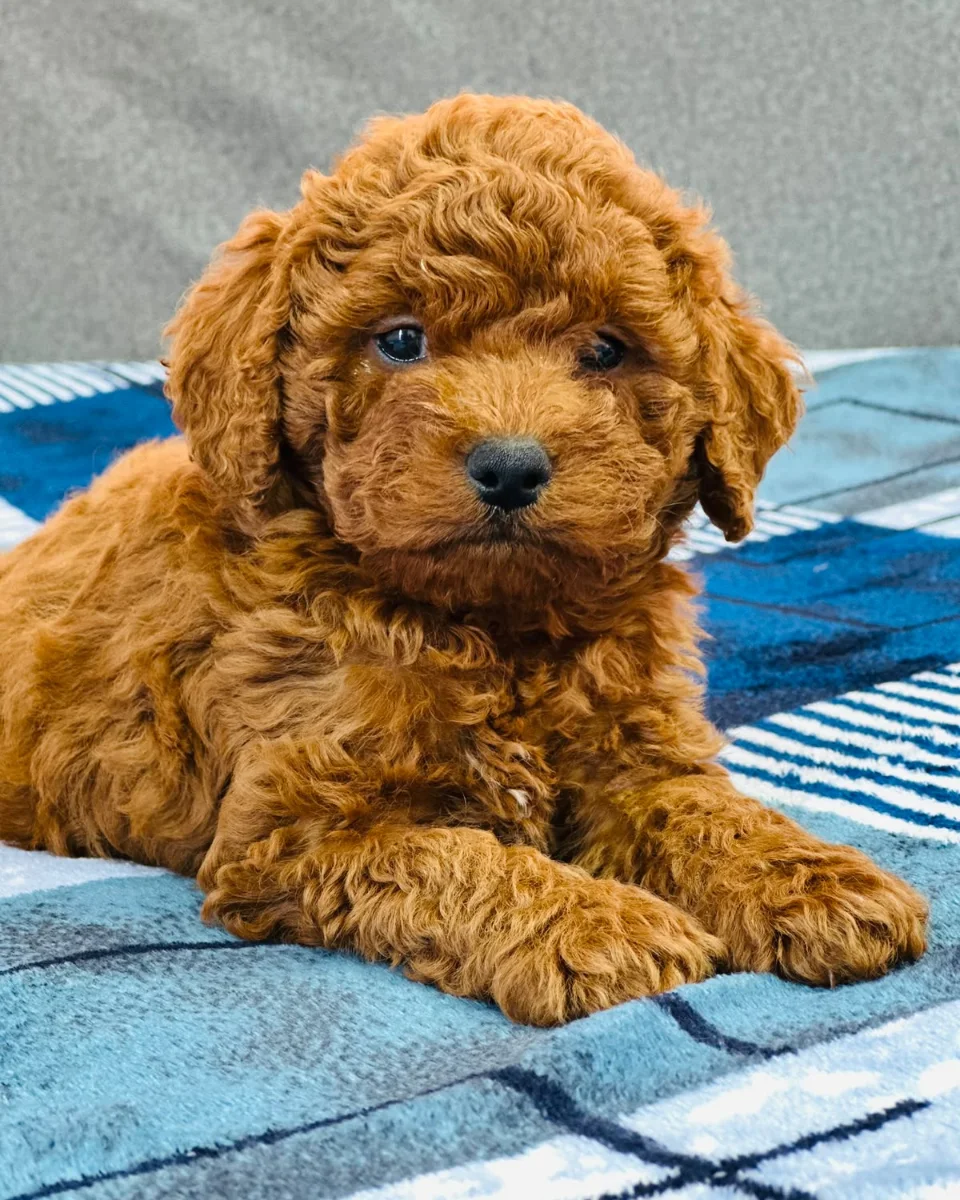
- Brush to the skin two to three times a week with a slicker brush, then check with a metal comb. If the comb catches, a mat is forming.
- Watch the friction points: behind the ears, the armpits, the collar and harness line, the backs of the legs and the base of the tail.
- Dry properly. After a bath or a wet walk, dry the coat right down to the skin. A damp curly coat mats quickly and traps moisture that leads to hot spots and ear infections, especially in humid weather.
- Check the ears weekly, keeping them clean and dry.
- Book a professional groom every six to eight weeks for life, at around ₹1,500 to ₹3,500 a session. In Bathinda, our grooming service at The Royal Paws can help keep a curly coat in good order.
If that sounds like more than you want to take on, an F1 is usually the more forgiving coat, and we will say so rather than place a curly-coated puppy in the wrong home.
Temperament and size
With more Poodle in the mix, F1Bs often think more like a Standard Poodle than a Golden Retriever: quick, attentive, eager to learn and easily bored. They bond closely with their household and do not cope well with being left alone all day, so they need daily walks, mental work and company.
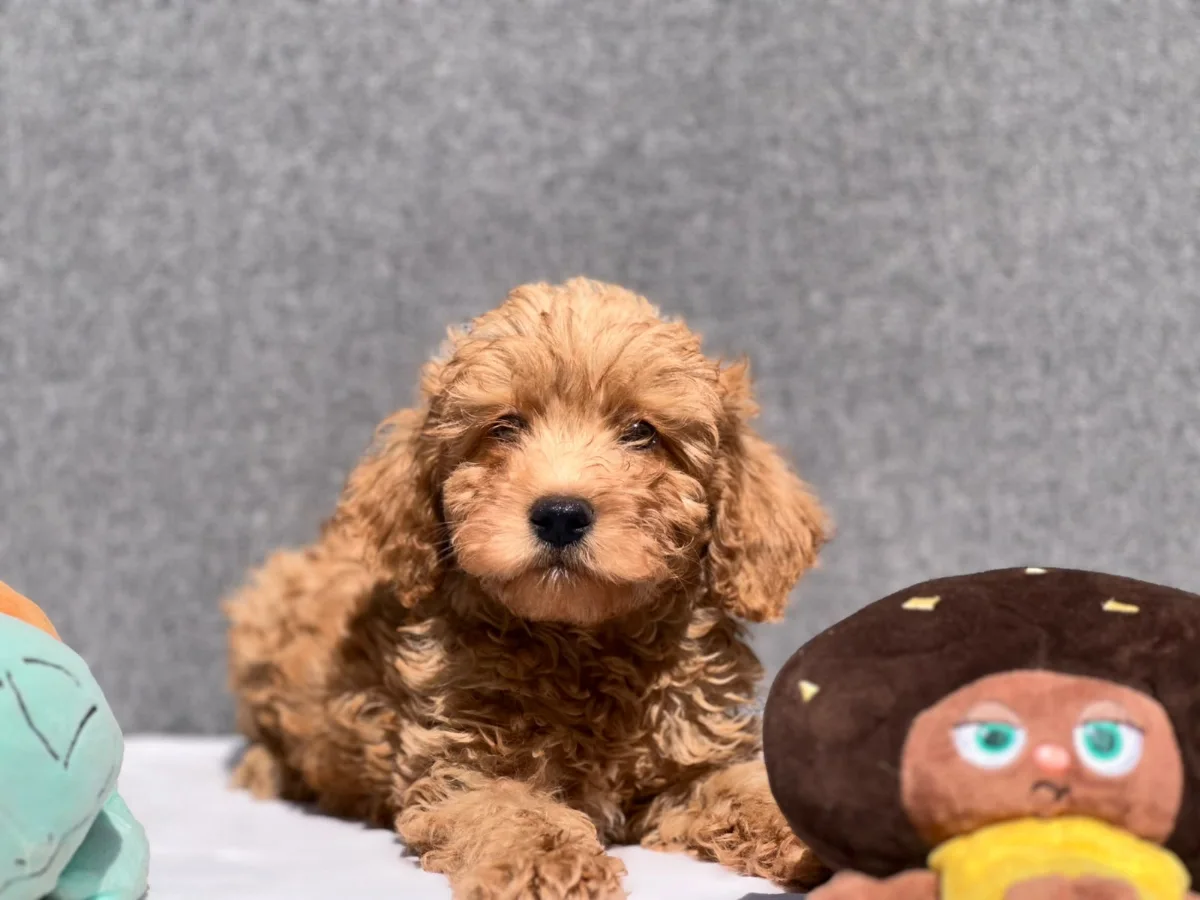
Size depends mainly on the Poodle used. An F1B bred with a Standard Poodle is a full-sized dog, usually around 50 to 60 cm at the shoulder and 20 to 30 kg when grown. Smaller Poodles give smaller puppies, so always ask about both parents' size. For more on the Poodle side of the cross, see our Standard Poodle guide.
Health: the backcross does not remove inherited risk
More Poodle in the mix does not make a puppy immune to inherited conditions. An F1B can still inherit risks from either side, including hip and elbow dysplasia and eye conditions such as progressive retinal atrophy. With a Standard Poodle parent, conditions associated with Standard Poodles, such as Addison's disease, sebaceous adenitis and bloat, are worth knowing about, alongside the Golden Retriever side's joint, heart and later-life cancer risks.
Coat DNA tests describe the coat, not the dog's health. What protects a puppy is health screening of both parents. Ask any breeder what each parent was screened for, and to see the results.
Questions to ask about an F1B litter
- Is this litter definitely F1B? Which parent is the F1 Goldendoodle, and which is the Poodle?
- Is the Poodle parent a Standard, a Miniature or a Toy? How big are both parents?
- What kind of coat does the F1 parent have?
- Have the parents been coat DNA tested, and what did the tests show?
- What were the parents health screened for, and can I see the results?
- Can I meet the mother, in person or on a live video call, with the litter?
A good breeder will answer all of these readily, and should be clear about a puppy's generation without being asked.
F1B Goldendoodle price and papers
F1B puppies are priced within our Goldendoodle tiers, set by lineage and documentation, not by coat or colour.
Pet quality
₹75,000 – ₹1,20,000
A healthy, well-socialised family companion from health-checked parents.
Documented lineage
₹1,20,000 – ₹1,85,000
Documented parentage, with the parents' pedigree records and complete health and vaccination records.
Champion bloodline
₹1,85,000 – ₹2,75,000
From titled Golden Retriever or Poodle lines, with health-tested parents.
Like any Goldendoodle, an F1B is a crossbreed, so it cannot be registered with the Kennel Club of India. For documented-lineage puppies, what we provide is documented parentage and copies of the parents' pedigree records, alongside every puppy's vet check, vaccination and deworming records.
Asking about an F1B Goldendoodle puppy
Our Goldendoodle litters are planned, and the generation varies from litter to litter. Ask us which generation our current or upcoming litter is. If an F1B is what you need, tell us why, whether allergies, shedding or something else, and we will be honest about the fit.
You can collect your puppy from us in Bathinda, which is also the best chance to meet the parents and see where the litter was raised. Yes. Your puppy travels by car with a responsible person, never alone as cargo, and we set up a live video call with you before delivery. Ask us about delivery timing and any cost for your city before you book. The Goldendoodle booking steps explain what happens after that.
We never ask for a deposit on the first call.
F1B Goldendoodle Questions
What does F1B mean in a Goldendoodle?
F1B means the puppy's parents are an F1 Goldendoodle (a first cross between a Golden Retriever and a Poodle) and a Poodle. The B stands for backcross: the litter has been bred back towards one of the original breeds, which for a Goldendoodle is the Poodle. By parentage, an F1B works out at about three-quarters Poodle.
Is an F1B Goldendoodle hypoallergenic?
No dog is hypoallergenic, and that includes an F1B. An F1B usually has a curlier coat that holds loose hair and dander in the coat rather than dropping it around the home, which many allergy-sensitive families find easier. It is a reduction, not a guarantee, so spend time with adult F1B Goldendoodles before committing if someone at home has allergies.
Do F1B Goldendoodles shed?
Usually very little, and typically less than an F1, but not nothing, and individual puppies vary. The shed hair mostly stays trapped in the curls, which is why it has to be brushed out regularly or it mats.
Is every F1B Goldendoodle 75% Poodle in looks and coat?
No. The 75% figure describes the average parentage, not how each puppy turns out. Coat type depends on the specific genes each puppy inherits, so an F1B litter can include curlier and wavier puppies. Coat DNA tests on the parents give a better guide than the percentage alone.
Should I choose an F1 or an F1B Goldendoodle?
If shedding or mild allergies are your main concern, an F1B is usually the better fit. If you would rather have a coat that is a little easier to care for and can accept a little more hair, an F1 is often the more forgiving choice. Both need regular professional grooming.
How big does an F1B Goldendoodle get?
It depends mainly on the Poodle used. With a Standard Poodle parent, expect a full-sized dog of roughly 50 to 60 cm at the shoulder and 20 to 30 kg. Smaller Poodles produce smaller dogs, so ask about both parents' size.
Does The Royal Paws have F1B Goldendoodle puppies available?
Availability changes from litter to litter. Ask us which generation our current or upcoming Goldendoodle litter is, and we will tell you honestly what we have and when the next litter is expected.
Is an F1B Goldendoodle more expensive?
Our Goldendoodle puppies are priced from ₹75,000 to ₹2,75,000 by lineage and documentation: pet quality ₹75,000 to ₹1,20,000, documented lineage ₹1,20,000 to ₹1,85,000, and champion bloodline ₹1,85,000 to ₹2,75,000. Ask us where a particular F1B puppy sits within those tiers.
Is an F1B Goldendoodle Right for You?
Tell The Royal Paws about your home, any allergies and how much grooming you can take on. We will tell you which generation our current litter is and whether it is a good fit.