
Goldendoodle Generations Explained: F1, F1B, F2 and Beyond
F1, F1B, F1BB, F2B, multigen: every label on a Goldendoodle litter describes who the puppy's parents were. Here is how to read them, what each one tends to mean for coat, shedding and grooming, and what no label can promise.
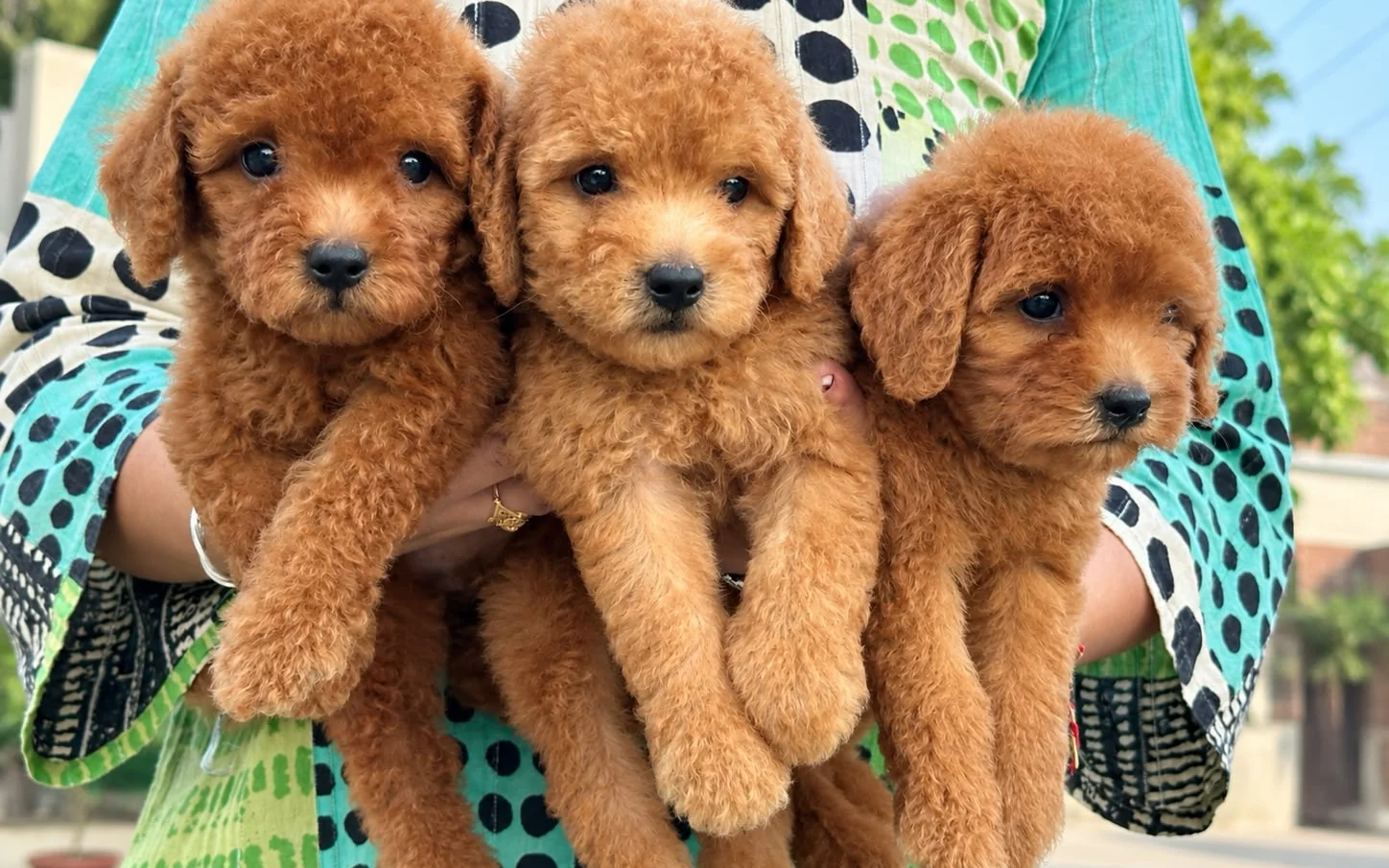
A Goldendoodle puppy, front and side
A short look at a Goldendoodle puppy from the front and the side, showing its soft, fluffy puppy coat. The video starts only when you press play.
- F
- Filial (offspring)
- Number
- Generations of doodle
- B
- Bred back to a Poodle
- Most common
- F1 and F1B
- Percentages
- Averages, not promises
A Goldendoodle's generation tells you its parents and the average share of Poodle in its make-up. It is a useful clue to coat and shedding, but not a guarantee: coat depends on the genes each puppy actually inherits. For the breed as a whole, read our Goldendoodle guide, or call 7791901085 to ask which generation our current litter is.
How to read a generation label
Every label is built from the same three parts:
- F stands for filial, meaning offspring. It is borrowed from genetics and simply marks the dog as a hybrid.
- The number counts generations of Goldendoodle. A 1 means the parents were two purebreds; a 2 means the parents were both Goldendoodles; a 3 means the grandparents were too.
- B means backcross: a Goldendoodle bred back to a purebred Poodle. Each extra B is one more backcross.
So an F1B is “a first-generation Goldendoodle, backcrossed once”, and an F1BB is the same dog backcrossed again. Once you know the pattern, a litter advert full of letters becomes a plain description of the parents.
Every common generation, by its parents
The Poodle percentage below is worked out from the parents: each puppy takes, on average, half its make-up from each parent. An F1B, for example, is half of an F1 (50% Poodle) plus half of a Poodle (100%), which averages 75%.
| Generation | Parents | Average Poodle share | In practice |
|---|---|---|---|
| F1 | Golden Retriever × Poodle | 50% | The first cross; the starting point for every other generation |
| F1B | F1 Goldendoodle × Poodle | 75% | The common backcross; bred for a curlier coat |
| F1BB | F1B Goldendoodle × Poodle | About 87.5% | A second backcross; very Poodle-like, less often bred |
| F2 | F1 Goldendoodle × F1 Goldendoodle | 50% | Same average as an F1, but the coat genes reshuffle |
| F2B | F1 × F1B Goldendoodle (sometimes F2 × Poodle) | About 62.5% (75% for F2 × Poodle) | Label used loosely; ask which pairing it means |
| F3 / Multigen | Goldendoodle × Goldendoodle, over several generations | Varies | Depends entirely on the dogs behind it |
| Reverse backcross | F1 Goldendoodle × Golden Retriever | 25% | Rarely bred on purpose; most likely to shed |
F2B is the label most often used loosely. Some breeders mean an F1 bred to an F1B, others an F2 bred to a Poodle, so ask which pairing a litter actually is. The same goes for “multigen”: ask what the parents and grandparents were.
Why the percentage does not decide the coat
A Poodle percentage is an average across a whole litter. Individual puppies do not inherit an average; they inherit specific genes. Three of those genes do most of the work in a Goldendoodle coat:
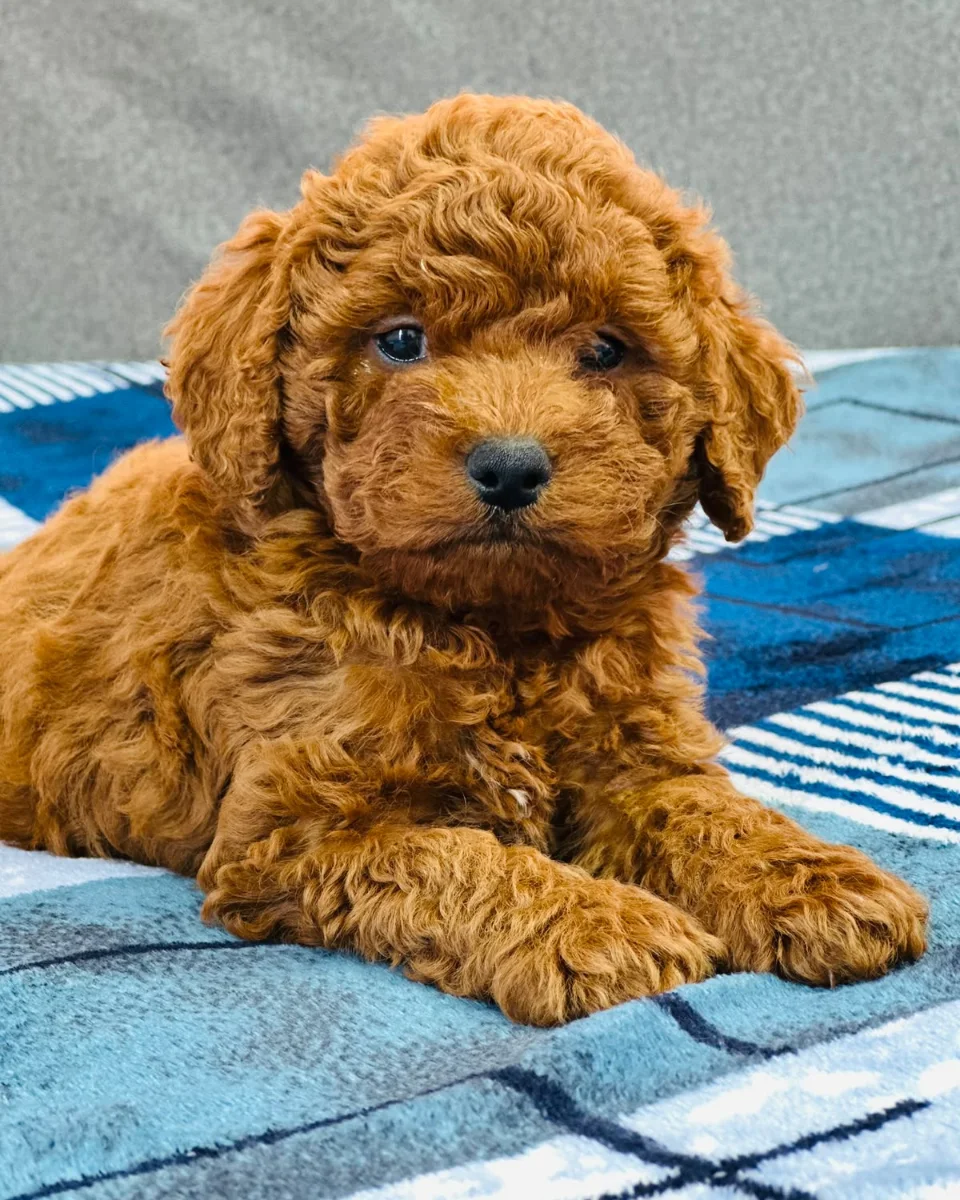
- Furnishings: the beard, eyebrows and longer face hair that make a doodle look like a doodle. Dogs without furnishings usually have a flat, shedding coat.
- Curl: whether the coat is straight, wavy or curly.
- Shedding: variants linked to how much a coat sheds.
Poodles usually carry two “doodle-type” copies of these genes, and Golden Retrievers usually carry none. Each puppy gets one copy of each gene from each parent, and that is what explains the pattern of the generations:
- F1: every puppy gets one copy from the Poodle and one from the Golden. That is why F1 coats are usually wavy and fairly alike across a litter.
- F1B: every puppy gets a Poodle copy from the Poodle parent, and either type from the F1 parent. Some puppies end up curlier, others wavier, but nearly all have furnishings.
- F2: both parents are F1s carrying one copy of each type, so the copies can recombine in any way. About one puppy in four can inherit two Golden-type copies of the furnishings gene and grow a flat, shedding coat.
This is why two puppies of the same generation, even from the same litter, can look and shed differently. Coat DNA tests on the parents show which versions they carry, and are a better guide to a litter than its label.
What each generation tends to be like
F1 Goldendoodle
The first cross: a purebred Golden Retriever and a purebred Poodle. Coats are usually wavy, sometimes shaggy or straighter. An F1 sheds far less than a Golden Retriever, but it does shed a little. The wavy coat mats more slowly than a curly one, which makes it the more forgiving choice for owners with less time for brushing. Temperament often leans towards the Golden Retriever's easy warmth.
F1B Goldendoodle
An F1 bred back to a Poodle. Coats are usually curlier and tighter, and the F1B is the generation most often chosen where shedding or mild allergies matter. The trade-off is grooming: the tighter the curl, the faster the coat mats. Our F1B Goldendoodle guide covers coat care, allergies and what to ask about an F1B litter in detail.
F1BB Goldendoodle
An F1B bred back to a Poodle again, around seven-eighths Poodle by parentage. Expect a very Poodle-like coat and, often, a quicker, more Poodle-like mind. At this point the Golden Retriever influence is small, so it is worth asking yourself whether a Standard Poodle would suit you just as well.
F2 Goldendoodle
Two F1s bred together. On paper it is still half and half, but the coat genes reshuffle, so one litter can hold a flat-coated puppy, a tightly curled one and everything in between. For a family choosing a Goldendoodle because it sheds less, that is the least predictable option.
F2B and multigen Goldendoodles
An F2B adds Poodle back into the mix, which usually makes coats curlier and more consistent than an F2. Multigen lines are bred Goldendoodle to Goldendoodle over several generations, ideally with coat and health testing at every step, to make coats more predictable. Done well, it takes years of careful pairing; done carelessly, the label means very little.
F1, F1B and F2 side by side
| F1 | F1B | F2 | |
|---|---|---|---|
| Parents | Golden Retriever × Poodle | F1 Goldendoodle × Poodle | F1 Goldendoodle × F1 Goldendoodle |
| Parentage | About 50% Poodle | About 75% Poodle | About 50% Poodle |
| Typical coat | Usually wavy; can be straighter | Usually curlier and tighter | Varies widely within one litter |
| Shedding | Low to moderate; varies from puppy to puppy | Usually the lowest, though not guaranteed | Least predictable |
| Grooming | Brush 2–3 times a week; a wavy coat is a little more forgiving | Brush 2–3 times a week to the skin; mats fastest | Depends on the coat each puppy ends up with |
| Predictability | Fairly consistent within a litter, but coats vary | More consistent curl, though individual puppies still vary | Low; very different coats can appear in one litter |
| Often suits | Families who want a lower-shedding dog with slightly easier coat care | Households where shedding or mild allergies are the main concern | Buyers who are flexible about coat type |
Whatever the generation, every Goldendoodle needs brushing to the skin and a professional groom every six to eight weeks, at around ₹1,500 to ₹3,500 a session. The generation changes how quickly a missed brushing turns into mats, not whether grooming is needed.
Generation and allergies
No Goldendoodle generation is hypoallergenic. Most dog allergies are a reaction to proteins in dander and saliva, which every dog produces. What generation can change is how much loose hair, carrying those proteins, ends up around your home: a curly coat tends to hold it in, a flatter coat tends to drop it.
That is why allergy-conscious families usually look at F1B and higher-Poodle generations, and avoid F2 litters and reverse backcrosses. Even then, reactions differ from person to person and dog to dog. If someone at home has allergies, spend time with adult Goldendoodles of the generation you are considering before you decide, and speak to your doctor if the allergy is more than mild.
Choosing a generation for your home
Three questions usually settle it:
- Does anyone at home react to dogs? If so, lean towards an F1B and test the reaction first. If not, an F1's easier coat may suit you better.
- How much brushing will really happen? Be honest. If it is once a week at best, a wavy F1 coat forgives that far more than a curly F1B.
- How humid is your city? A curly coat holds moisture against the skin. In a coastal or monsoon-heavy city, a curlier generation needs thorough drying after every wet walk and bath; in a drier climate the difference matters less.
We would rather talk you out of a generation than place a puppy whose coat you will struggle with, so tell us about your home and routine when you enquire.
What a generation cannot tell you
- Size. Size depends on whether the Poodle was a Standard, Miniature or Toy, and on both parents. See the parents to know what to expect.
- Health. A generation does not screen out inherited conditions. Health screening of both parents does; ask what they were tested for.
- Temperament. The parents' temperament and how the litter is raised shape an adult dog far more than its generation.
- Quality. More letters do not mean a better dog. A well-bred F1 from screened parents is a better choice than a carelessly bred multigen.
- Papers. Every generation is a crossbreed, so no Goldendoodle can be registered with the Kennel Club of India. What can be documented is the parentage.
To check a generation claim, ask the breeder to name both parents and say what each one is: a Golden Retriever, a Poodle (and which size), or a Goldendoodle of which generation. A breeder who knows their litter answers that at once.
Does generation change the price?
Not at The Royal Paws. Our Goldendoodle puppies are priced from ₹75,000 to ₹2,75,000 by lineage and documentation, whatever their generation, coat or colour.
Pet quality
₹75,000 – ₹1,20,000
A healthy, well-socialised family companion from health-checked parents.
Documented lineage
₹1,20,000 – ₹1,85,000
Documented parentage, with the parents' pedigree records and complete health and vaccination records.
Champion bloodline
₹1,85,000 – ₹2,75,000
From titled Golden Retriever or Poodle lines, with health-tested parents.
The full price breakdown, running costs and what comes with every puppy are on our Goldendoodle page.
Which generation is our current litter?
Our Goldendoodle litters are planned, and the generation varies from litter to litter. Call or email to ask which generation the current or upcoming litter is. We will name both parents, and you can meet the mother in Bathinda or on a live video call.
You can collect your puppy from us in Bathinda, which is also the best chance to meet the parents and see where the litter was raised. The booking steps explain what happens next.
We never ask for a deposit on the first call.
Goldendoodle Generation Questions
What are the Goldendoodle generations?
The main ones are F1 (Golden Retriever × Poodle), F1B (F1 Goldendoodle × Poodle), F1BB (F1B × Poodle), F2 (F1 × F1), F2B (usually F1 × F1B) and multigen, meaning several generations of Goldendoodles bred together. Each label simply describes the puppy's parents.
What does the B mean in F1B?
B stands for backcross. The puppy's F1 Goldendoodle parent has been bred back to one of the original breeds, which for a Goldendoodle is the Poodle. Two backcrosses in a row is written F1BB.
Which Goldendoodle generation sheds the least?
Generations with more Poodle in them, usually F1B and F1BB, tend to shed the least. It is a tendency, not a guarantee: two puppies from the same litter can shed differently, and no Goldendoodle generation is free of shedding.
Is a higher Poodle percentage always better?
No. More Poodle usually means a curlier, lower-shedding coat, but also more grooming and a coat that mats faster in humid weather. The percentage is only an average, and it says nothing about health or temperament. The right generation is the one that fits your home.
Why do some F2 Goldendoodles shed like a Golden Retriever?
Both F1 parents usually carry one copy of the Golden Retriever version of the furnishings gene. When two F1s are bred, about one puppy in four can inherit two of those copies and grow a flat, shedding coat without the doodle beard and eyebrows. Coat DNA tests on the parents can reduce that risk.
Is multigen better than F1B?
Not automatically. Multigen only means several generations of Goldendoodles bred together. Carefully bred multigen lines can be very consistent, but the label alone tells you nothing about how carefully the parents were chosen. Ask about the parents' coat tests and health screening, whatever the generation.
Does the generation change a Goldendoodle's size?
No. Size depends mainly on whether the Poodle used was a Standard, Miniature or Toy, and on the size of both parents. An F1 and an F1B bred from Standard Poodles are both full-sized dogs.
Which generation are The Royal Paws' Goldendoodle puppies?
The generation varies from litter to litter. Ask us which generation our current or upcoming litter is, and we will tell you plainly, name both parents, and explain what that means for the puppies' likely coats.
Not Sure Which Generation Suits You?
Tell The Royal Paws about your home, any allergies and how much grooming you can manage. We will explain which generation our current litter is and whether it fits.